《Deep Learning with Python》笔记[5]
Deep learning for text and sequences
空间上的序列,时间上的序列组成的数据,比如文本,视频,天气数据等,一般用recurrent neural network(RNN)和1D convnets
其实很多名词,包括convnets,我并没有在别的地方看到过,好像就是作者自己发明的,但这些不重要,知道它描述的是什么就可以了,不一定要公认术语。
通用场景:
- [分类: 文本分类] Document classification and timeseries classification, such as identifying the topic of an article or the author of a book
- [分类: 文本比较] Timeseries comparisons, such as estimating how closely related two documents or two stock tickers are
- [分类: 生成] Sequence-to-sequence learning, such as decoding an English sentence into French
- [分类: 情感分析]Sentiment analysis, such as classifying the sentiment of tweets or movie reviews as positive or negative
- [回归: 预测]Timeseries forecasting, such as predicting the future weather at a certain location, given recent weather data
我画蛇添足地加了是分类问题还是回归问题.
none of these deeplearning models truly understand text in a human sense
Deep learning for natural-language processing is pattern recognition applied to words, sentences, and paragraphs, in much the same way that computer vision is pattern recognition applied to pixels.
tokenizer
图像用像素上的颜色来数字化,那文字也把什么数字化呢?
- 拆分为词,把每个词转化成向量
- 拆分为字(或字符),把每个字符转化为向量
- 把字(词)与前n个字(词)组合成单元,转化为向量,(类似滑窗),N-Grams
all of above are tokens, and breaking text into such tokens is called tokenization. These vectors, packed into sequence tensors, are fed into deep neural networks.
N-grams这种生成的token是无序的,就像一个袋子装了一堆词:bag-of-words: a set of tokens rather than a list of sequence.
所以句子结构信息丢失了,更适合用于浅层网络。作为一种rigid, brittle(僵硬的,脆弱的)特征工程方式,深度学习采用多层网络来提取特征。
vectorizer
token -> vector:
- one-hot encoding
- token/word embedding (word2vec)
one-hot
- 以token总数量(一般就是字典容量)为维度
- 一般无序,所以生成的时候只需要按出现顺序编索引就好了
- 有时候也往往伴随丢弃不常用词,以减小维度
- 也可以在字符维度编码(维度更低)
- 一个小技巧,如果索引数字过大,可以把单词hash到固定维度(未跟进)
特点/问题:
- sparse
- high-dimensional, 比如几千几万
- no spatial relationship
- hardcoded
word embeddings
- Dense
- Lower-dimensional,比如128,256...
- Spatial relationships (语义接近的向量空间上也接近)
- Learned from data
to obtain word embeddings:
- 当成训练参数之一(以Embedding层的身份),跟着训练任务一起训练
- pretrained word embeddings
- Word2Vec(2013, google)
- CBOW
- Skip-Gram
- GloVe(2014, Stanford))
- 前提是语言环境差不多,不同学科/专业/行业里的词的关系是完全不同的
- GloVe从wikipedia和很多通用语料库里训练,可以尝试在许多非专业场景里使用。
- Word2Vec(2013, google)
keras加载训练词向量的方式:
model.layers[0].set_weights([embedding_matrix])
model.layers[0].trainable = False
pytorch:
# TEXT, LABEL为torchtext的Field对象
from torchtext.vocab import Vectors
vectors=Vectors(name='./sgns.sogou.word') #使用预训练的词向量,维度为300Dimension
TEXT.build_vocab(train, vectors=vectors) #构建词典
LABEL.build_vocab(train)

vocab_size = len(TEXT.vocab)
vocab_vectors = TEXT.vocab.vectors.numpy() #准备好预训练词向量

self.embedding = nn.Embedding(num_embeddings=vocab_size, embedding_dim=embedding_size)

# 上面是为了回顾,真正用来做对比的是下面这两句
self.embedding.weight.data.copy_(torch.from_numpy(vocab_vectors))
self.embedding.weight.requires_grad = False
预训练词向量也可以继续训练,以得到task-specific embedding
Recurrent neural networks(RNN)
sequence, time series类的数据,天然会受到前后数据的影响,RNN通过将当前token计算的时候引入上一个token的计算结果(反向的话就能获得下一个token的结果)以获取上下文的信息。
前面碰到的网络,数据消费完就往前走(按我这种说法,后面还有很多“等着二次消费的”模块,比如inception, resdual等等),叫做feedforward network。显然,RNN中,一个token产生输出后并不是直接丢给下一层,而是还复制了一份丢给了同层的下一个token. 这样,当前token的output成了下一个token的state。
- 因为一个output其实含有“前面“所有的信息,一般只需要最后一个output
- 如果是堆叠多层网络,则需要返回所有output
序列过长梯度就消失了,所谓的遗忘 (推导见另一篇笔记,) -> LSTM, GRU
Long Short-Term Memory(LSTM)
- 想象有一根传送带穿过sequence
- 同一组input和state会进行三次相同的线性变换,有没有联想到
transformer用同一个输出去生成q, k, v?
output_t = activation(dot(state_t, Uo) + dot(input_t, Wo) + dot(C_t, Vo) + bo)
i_t = activation(dot(state_t, Ui) + dot(input_t, Wi) + bi)
f_t = activation(dot(state_t, Uf) + dot(input_t, Wf) + bf)
k_t = activation(dot(state_t, Uk) + dot(input_t, Wk) + bk)

c_t+1 = i_t * k_t + c_t * f_t  # 仍然有q,k,v的意思(i,k互乘,加上f, 生成新c)
不要去考虑哪个是遗忘门,记忆门,还是输出门,最终是由weights决定的,而不是设计。
Just keep in mind what the LSTM cell is meant to do:
allow past information to be
reinjectedat a later time, thus fighting the vanishing-gradient problem.
关键词:reinject
dropout
不管是keras还是pytorch,都帮你隐藏了dropout的坑。 你能看到应用这些框架的时候,是需要你把dropout传进去的,而不是手动接一个dropoutlayer,原因是需要在序列每一个节点上应用同样的dropout mask才能起作用,不然就会起到反作用。
keras封装得要复杂一点:
model.add(layers.GRU(32,
                    dropout=0.2,
                    recurrent_dropout=0.2,
                    input_shape=(None, float_data.shape[-1])))
stacking recurrent layers
前面说过,设计好的模型的一个判断依据是至少让模型能跑到overfitting。如果到了overfitting,表现还不是很好,那么可以考虑增加模型容量(叠更多层,以及拓宽layer的输出维度)
堆叠多层就需要用到每个节点上的输出,而不只关心最后一个输出了。
Bidriectional
keras奇葩的bidirectional语法:
model.add(layers.Bidirectional(layers.LSTM(32)))
其实这是设计模式在类的封装上的典型应用,善用继承和多态,无侵入地扩展类的方法和属性,而不是不断魔改原代码,加参数,改API。但在脚本语言风格里的环境里,这么玩就有点格格不入了。
Sequence processing with convnets
- 卷积用到序列上去也是可以的
- 一个向量只表示一个token,如果把token的向量打断就违背了token是最小单元的初衷,所以序列上的卷积,不可能像图片上两个方向去滑窗了。(
Conv1D的由来) - 一个卷积核等于提取了n个关联的上下文(有点类似
n-grams),堆叠得够深感受野更大,可能得到更大的上下文。 - 但仍然理解为filter在全句里提取局部特征
归桕结底,图片的最小单元是一个像素(一个数字),而序列(我们这里说文本)的最小单元是token,而token又被我们定义为vector(一组数字)了,那么卷积核就限制在至少要达到最小单元(vector)的维度了。
Combining CNNs and RNNs to process long sequences
卷积能通过加深网络获取更大的感受野,但仍然是“位置无关”的,因为每个filter本就是在整个序列里搜索相同的特征。
但是它确实提取出了特征,是否可把位置关系等上下文的作业交给下游任务RNN做呢?
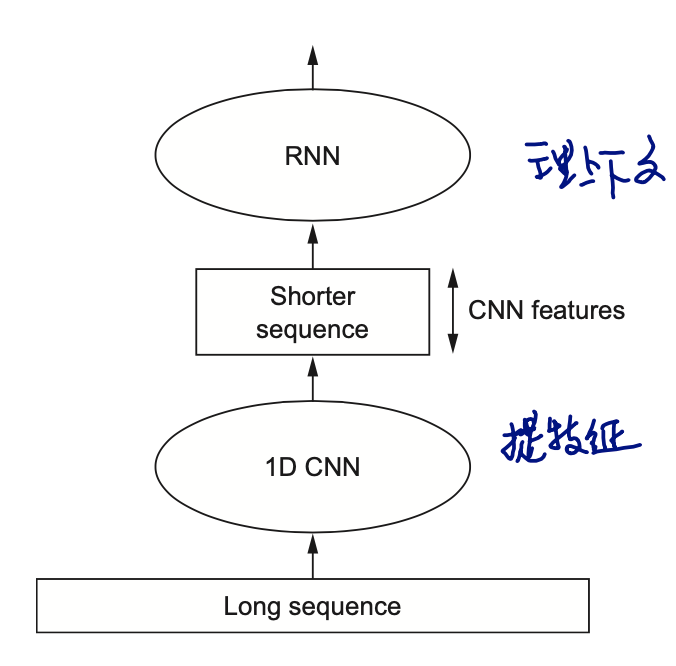
不但实现,而且堆叠两种网络,还可以把数据集做得更大(CNN是矩阵运算,还能用GPU加速)。